

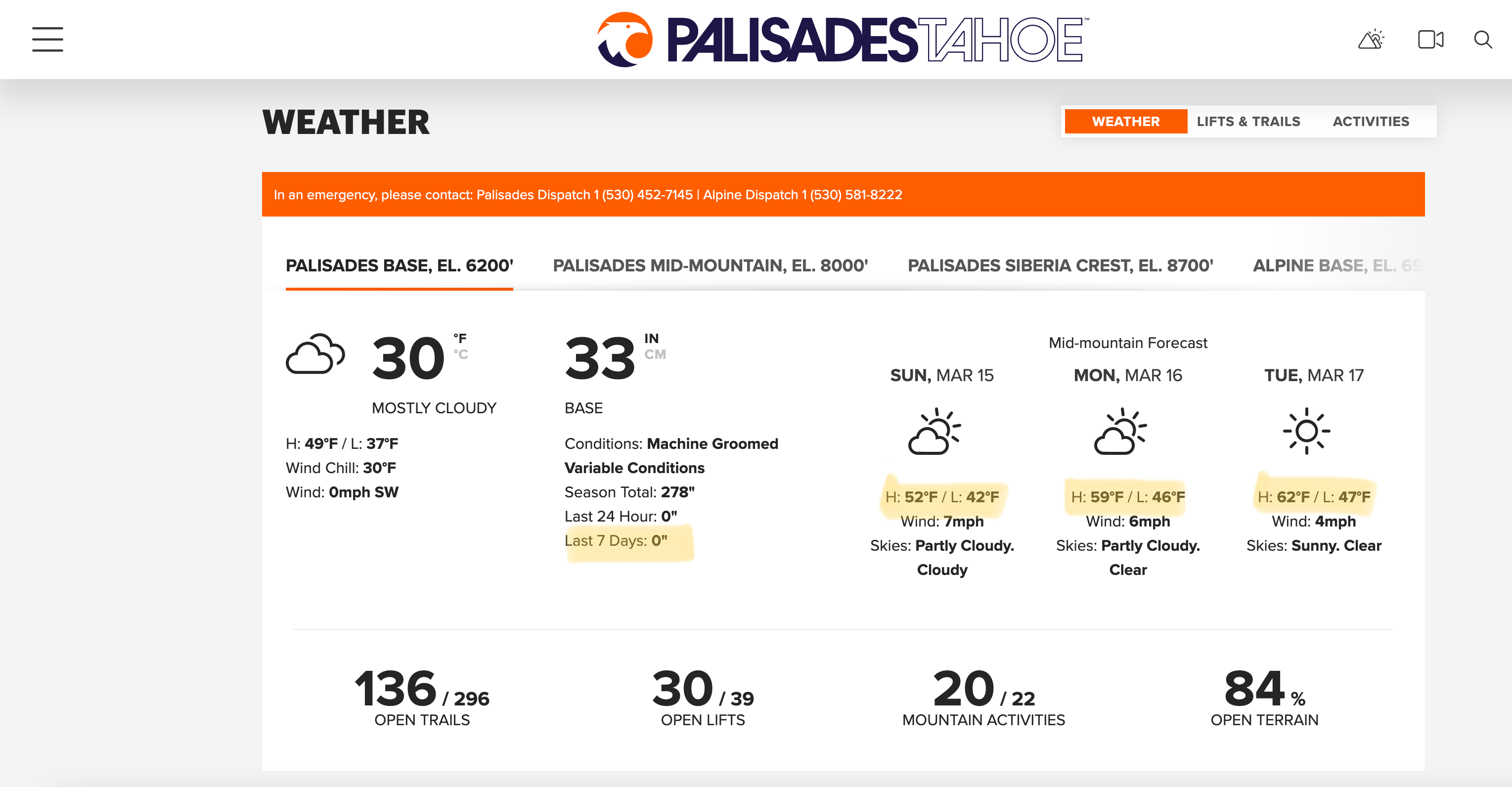
My friends and I just got up to Tahoe, and we’re planning to hit the slopes today at Palisades. The forecast? A high of 49°F, and it’s going to be slushy. The next few days are forecasting high-50s to low-60s. Last year, when we came up in mid-March, it snowed the entire time. Those were some of the better fresh tracks that I’ve seen in my days of snowboarding. But today, I’m expecting to be on the lookout for limited snow coverage and quietly mourning the beginning of the end for the season.
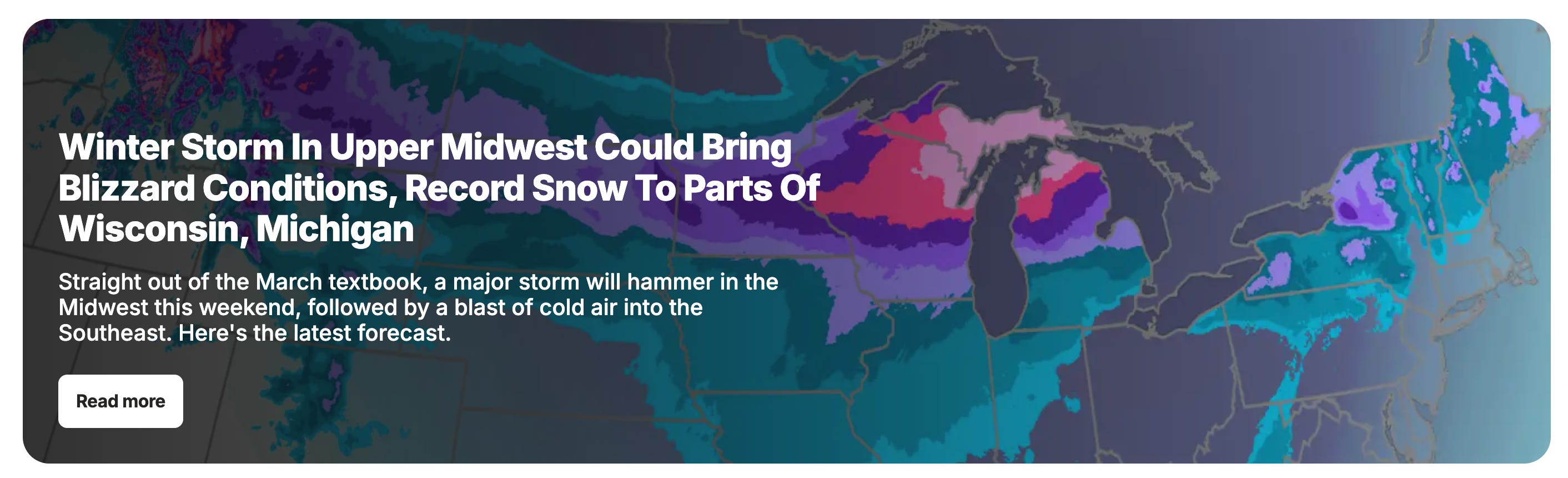
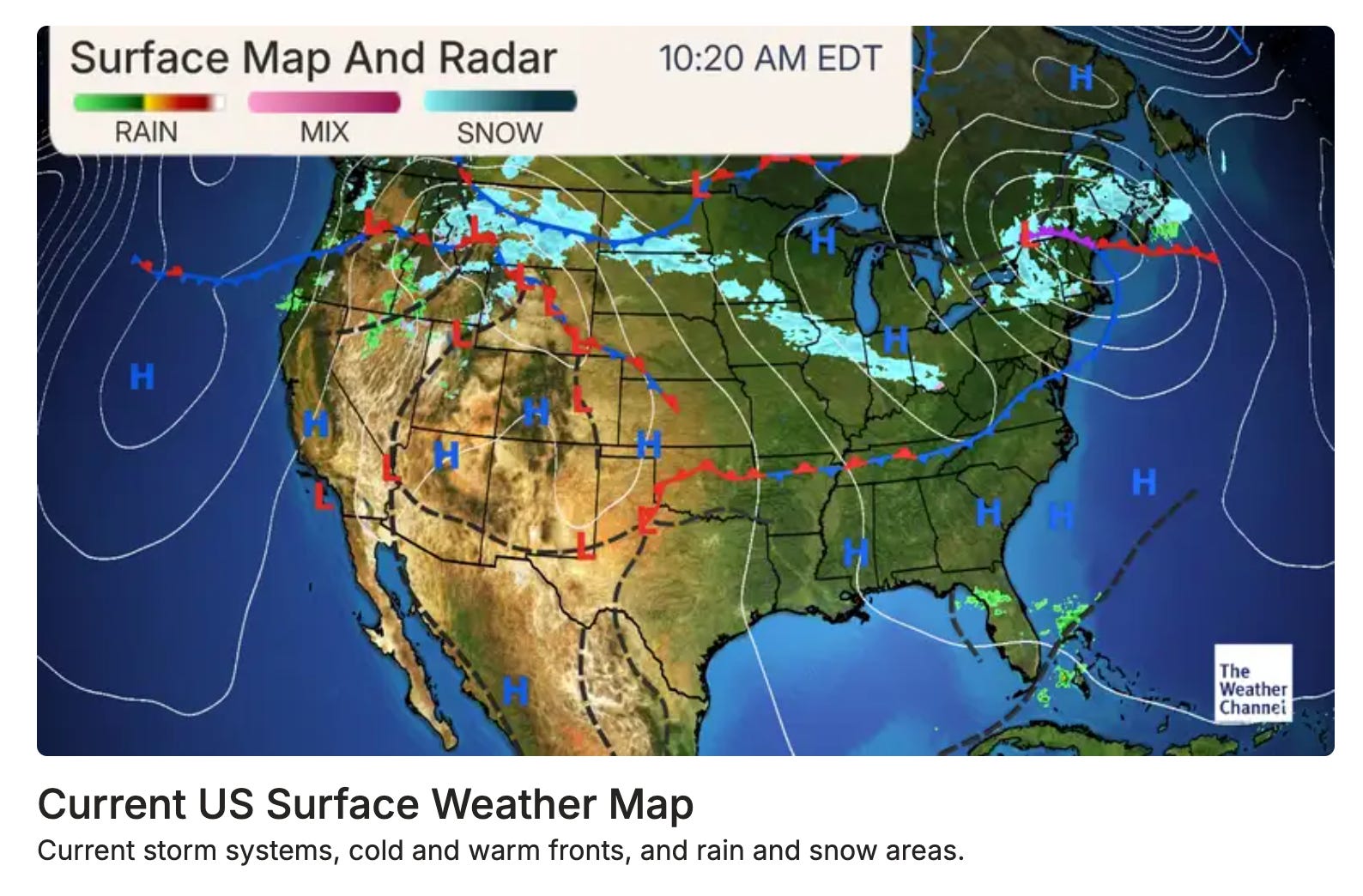
Here’s what makes this all stranger, though. While I’m riding groomers in a t-shirt, the Salton Sea in Southern California is tracking toward 114°F. That would shatter the national March heat record by six degrees. Meanwhile the Pacific Northwest is expecting new snow. And the upper Midwest? Blizzard conditions. Record snowfall expected in parts of Wisconsin and Michigan.

One country. One weekend. Four completely different weather realities — happening at the same time.
And our weather apps saw all of it coming.
That app didn’t just get lucky. Behind every forecast — the temperature, the storm warning, that “60% chance of snow” notification you ignored — there are machine learning models running calculations at a scale no human meteorologist could pull off alone. What most people don’t think about is that those models aren’t all doing the same thing. They’re actually answering two very different kinds of questions. And once you see the difference, you’ll start noticing it everywhere. I mean that literally.
A Dimmer Switch and a Light Switch
At their core, machine learning models are pattern-recognition engines. If you feed them enough historical data, they can learn to make predictions about things they haven’t encountered yet. Simple enough concept. But the type of prediction matters a lot — and it basically splits into two camps.
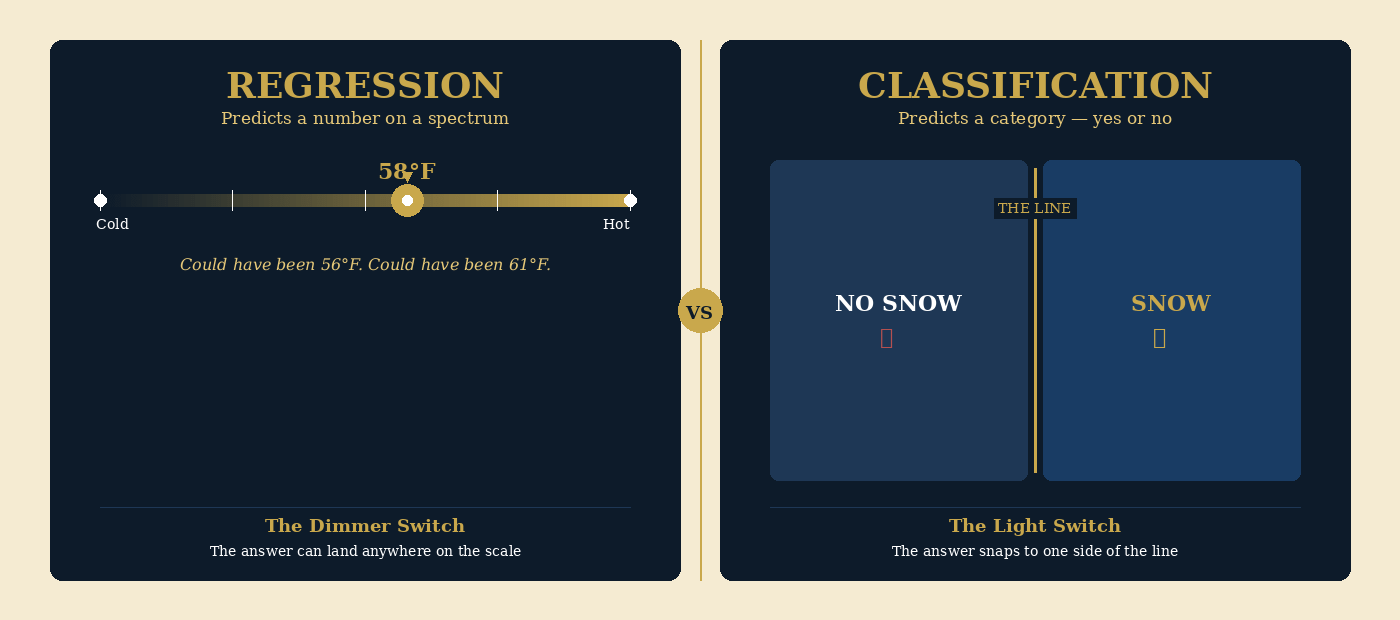
The first is called regression. Regression models answer questions that occur on a spectrum. Things like … How much? How long? How likely, expressed as an actual number? The output is always a value that could land anywhere along a continuous scale. When your weather app tells you tomorrow's high will be 52°F, that's a regression model at work. It could have said 50°F. It could have said 61°F. The answer lives on a sliding scale, and the model's job is to find the most accurate point on it. Think of it like a dimmer switch where the result isn't just on or off. It can land anywhere between the two extremes. Linear regression and gradient boosting are common examples, though honestly the math behind them matters a lot less than the type of question they're built to answer.
The second is classification. Classification models answer questions with defined categories. Will it or won’t it? Yes or no? Which bucket? When your weather app alerts you about a blizzard warning in Milwaukee, a classification model drew a line and made a call. Not how much snow (that’s regression) but is this a blizzard-level event, yes or no? The output is a decision, not a measurement. Think of it like a light switch. It’s either on or off. The answer snaps to one side of a boundary. Logistic regression and random forest models are common here, though again — the name is less important than the concept it represents.
Dimmer switch. Light switch. That’s genuinely the whole idea.
You’ve Seen These Models Before
Once you have that framework, you will start noticing these two types of questions everywhere. Here are a few places you’ve probably already encountered them, maybe without realizing it.
In the hospital. Healthcare might be the most consequential place machine learning operates today, and possibly one of the least well known. When a patient is discharged, hospitals often run a regression model to generate a readmission risk score. Something like: “this patient has a 74% probability of returning within 30 days.” That’s a number on a spectrum, and it shapes everything from discharge planning to how follow-up care gets resourced. In contrast, when a radiologist pulls up a scan and an AI flags a suspicious mass, that’s a classification model doing the work. Does this image show a malignancy — yes or no? The stakes of getting that wrong are about as serious as it gets. Both types of models are running in the same building, sometimes on the same patient, asking completely different kinds of questions.
In a company’s CRM. If you’ve worked anywhere near a sales organization, you’ve possibly seen regression and classification running side by side without knowing that’s what it was. A regression model looks at an open deal and estimates its value — “this opportunity is worth around $180,000.” That number quietly shapes how much time and energy a sales team puts into closing the deal. A classification model looks at an inbound lead and asks something simpler: “Is this even worth pursuing?” Yes or no. That answer triggers (or doesn’t) an entire sequence of outreach and follow-up. Thousands of those micro-decisions get made every day, across every sales org in the world. Most of them now have a model somewhere in the loop.
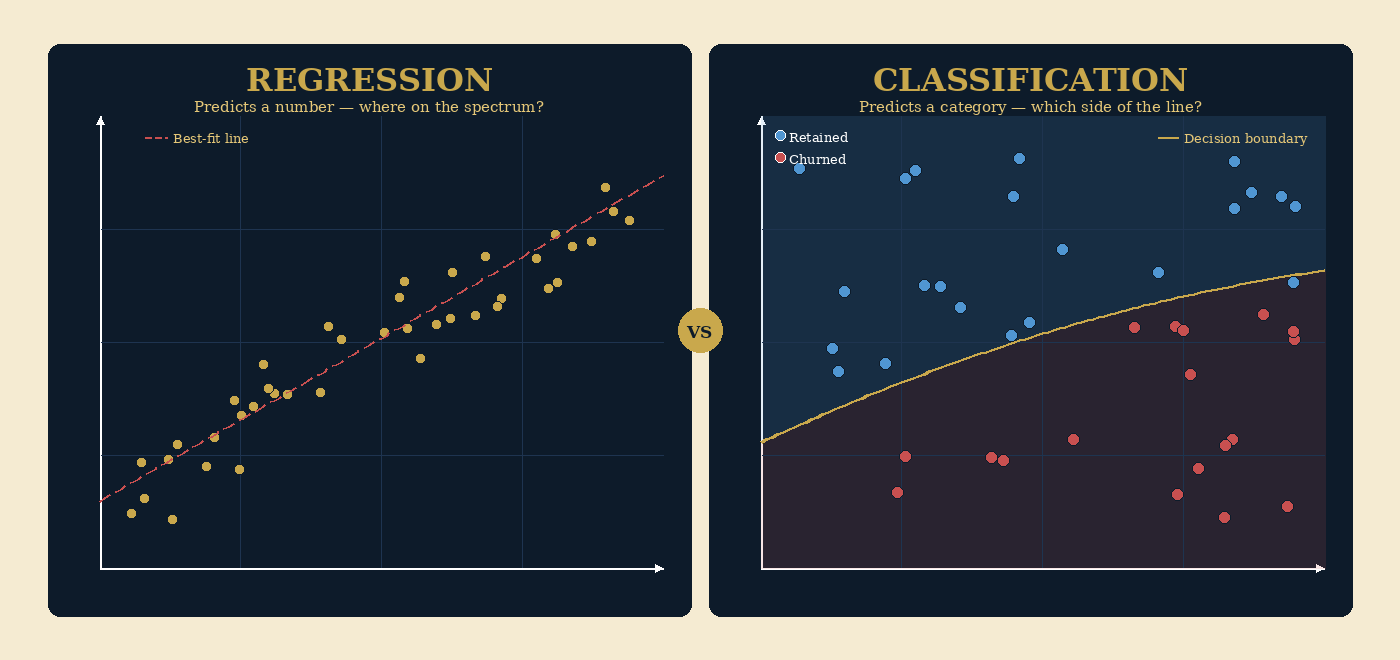
In your marketing dashboard. Customer lifetime value (LTV) is the estimated revenue a single customer generates over time and it’s probably the output of a regression model. It’s a dollar figure on a spectrum, and it drives decisions about how much to spend acquiring new customers and how much to invest keeping existing ones. But the moment a company starts asking “is this customer about to cancel?” (churn), that’s a classification question. Churn models draw a line and sort people into two buckets: at risk, or not. The ones who land on the “wrong side” get a retention offer, a discount, or a check-in call. The model isn’t agonizing over degrees of risk on some infinite scale. It just makes a call and moves on.
The Decoder Ring
Here’s a test you can apply pretty much anywhere: Is this giving me a number, or making a decision?
A Zillow estimate? —> Number. —> Regression.
A fraud alert on your credit card? —> Decision. —> Classification.
Your Spotify “taste match” percentage? —> Number. —> Regression.
The spam filter quietly keeping your inbox clean? —> Decision. —> Classification.
That question (number or decision) sits at the seam between two of the most widely deployed categories of machine learning models in the world. And now that you can see the seam, you’ll start noticing it in places you never thought to look.
I’m heading out to Palisades now. The regression model already handed me a temperature. The classification model already told me not to expect powder. Both are almost certainly right.
I’m going anyway. The slushy spring ski-ing (snowboarding) will still be pretty good. And company of friends even better.
Regression and classification are two of the foundational building blocks of applied machine learning. If you want to go deeper, the next layer worth understanding is how these models actually learn from data — a story about something called training, and it's more intuitive than you'd expect.
Good info. Thank you Jeffrey.
Such a helpful overview of two concepts I previously knew nothing about. Thanks Jeff!