

Every May during my college years, the ritual was the same. I would haul three months’ worth of my life back into my parents’ house—a chaotic mix of heavy textbooks, frantic exam notes, and laundry that had seen better days.
In that moment of transition, my “data” existed in three very different states.
I had my daily planner in my back pocket—the immediate source of truth for where I needed to be and who I needed to call. I had my final papers, some bills, and a couple bank statements, which were carefully filed away into a desk drawer for future reference. And then, there was the rest of it: the half-finished notebooks, the random handouts, and the boxes of “stuff” that I didn’t have the heart to throw away but didn’t have the space to organize.
That third category always ended up in the attic.
In the tech world, we use intimidating terms like Databases, Data Warehouses, and Data Lakes. But at their core, these are just the three rooms of a modern business’s mind. If you want to understand how AI is actually changing the world, you have to understand how we move information between the Planner, the Cabinet, and the Attic.
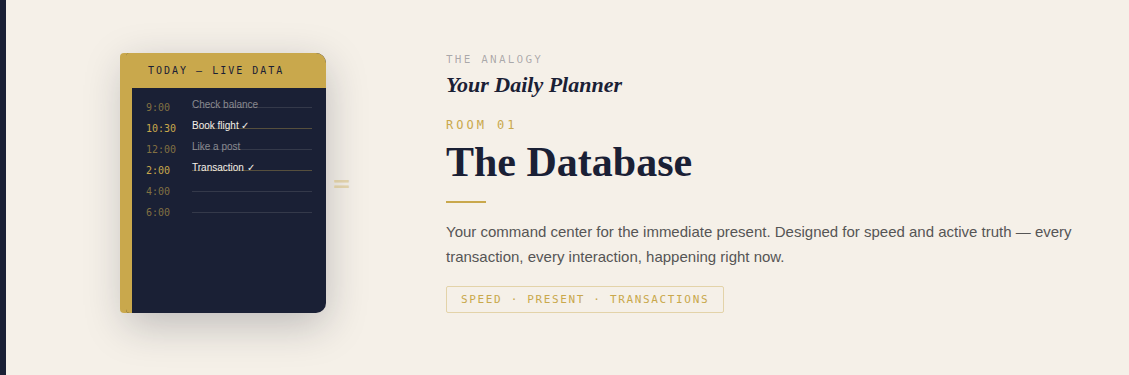
1. The Database: Your Daily Planner
A Database is your command center for the immediate present.
When you check your bank balance, book a flight, or “like” a post, you are interacting with a database. It is designed for speed and “active truth.” Think of it as your spiral-bound daily planner. It’s where you scribble down a 2:00 PM meeting or cross off a grocery item.
In technical circles, we say databases handle “transactions,” but for the rest of us, they handle reality. If you lose your planner, your day falls apart. If a company’s database fails, the “Now” simply stops working. It is the most vital, yet most short-sighted, room in the house.
2. The Data Warehouse: The Filing Cabinet
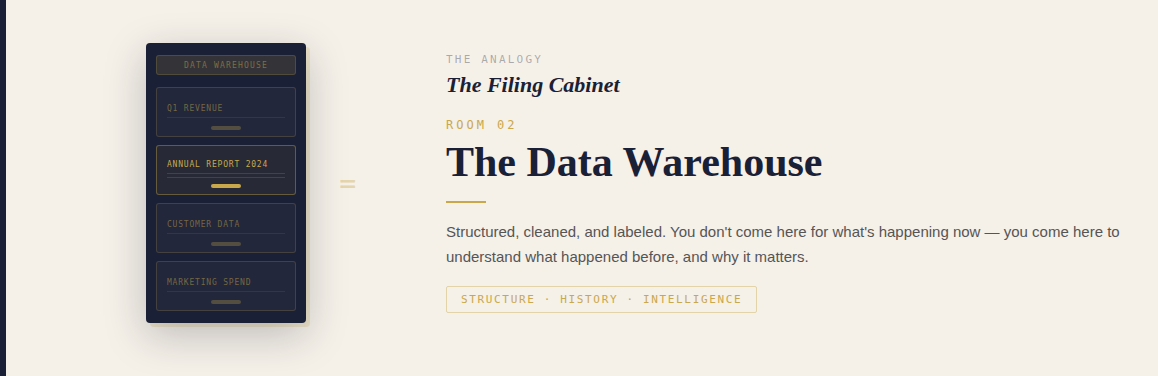
A Data Warehouse is the metal filing cabinet tucked in the corner of the home office.
You don’t go here to see what time your next meeting is; you go here to see how your expenses from last year compare to this year. This is “structured data”—information that has been scrubbed of its messiness, labeled, and placed into a specific folder.
There is a strict barrier to entry here. Just as you wouldn’t throw a muddy shoe into a folder of tax returns, data must be “cleaned” before it enters the warehouse. This ensures that when you look for an answer, the answer is reliable. It is the room where we turn raw activity into institutional intelligence.
3. The Data Lake: The Attic
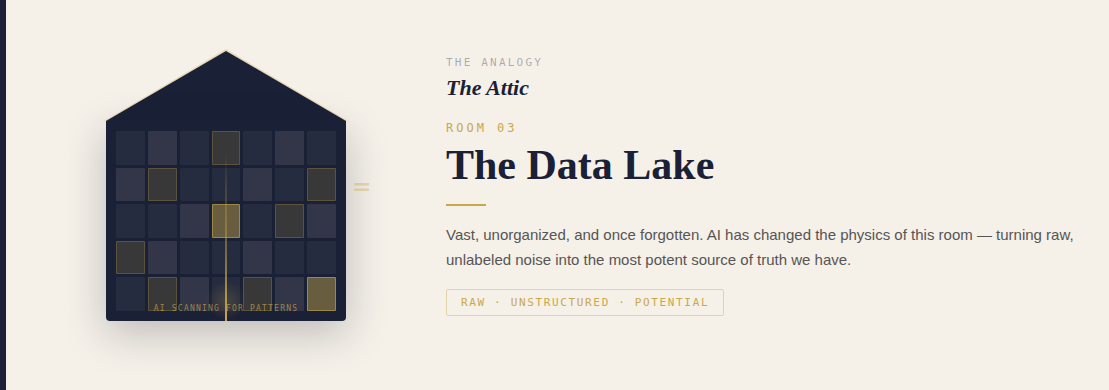
The Data Lake is the attic—the vast, unorganized “everything else.”
For decades, the attic was where information went to be forgotten. It held the raw, unedited footage of our lives: the half-finished ideas, the sensor logs from a factory floor, or the millions of customer service transcripts.
Searching the attic used to be too expensive and too slow. We only valued what was in the filing cabinet because we could actually find it. But AI has changed the physics of this room. AI is the “super-assistant” capable of sprinting through your attic, reading every unlabeled letter in a dusty box, and finding the one pattern that connects a childhood hobby to a mid-life career shift.
The Data Lake is no longer a graveyard of old files; it is the most potent source of “raw truth” we have.
These three rooms don't operate in isolation. Data moves between them — a transaction recorded in the planner gets summarized into the cabinet at month's end, while the raw exhaust of everything else quietly accumulates in the attic. For decades, businesses managed all three but only truly valued two of them. The attic was tolerated, not treasured. That's the part AI is changing.
The Intelligence of the Unorganized
We are entering a period where the socio-economic value of “The Attic” is skyrocketing.
For the last twenty years, businesses were obsessed with their filing cabinets. They only cared about the neat, summarized facts they had bothered to label, ignoring the “noise” of the attic because it was too messy to manage.
But AI thrives on noise. The most successful organizations of the next decade won’t necessarily be the ones with the cleanest filing cabinets; they will be the ones with the deepest attics. They’ve saved everything—every raw interaction and every minor detail—betting that one day, an algorithm would be smart enough to make sense of it.
Don’t just ask if your team is “collecting data.” Ask where they are putting it. If you are only keeping what fits in the planner or the cabinet, you are deleting your future. In the AI era, the most profound insights aren’t found in what we’ve decided to remember, but in the raw memory we haven’t yet bothered to organize.