
How Does ChatGPT Actually Learn?
Understanding LLMs, Part 2 of 3: Neural Networks & Model Training

This is Part 2 of a 3-Part Article Series. If you didn’t catch the first article, How Does ChatGPT Actually Read? — Understanding LLMs: Tokens & Vectorization, click here.
Nate passed his sommelier exam on a Tuesday in October.
I know this because he texted me a single photo of a glass of Burgundy, no caption, no context, just the photo. But I understood.
Something quieter happened in the months after that exam, something I didn’t notice until much later. The way he moved through the world had changed. At restaurants, he’d glance at a wine list for thirty seconds and just know. He wouldn’t recite a memorized answer. He just knew in a way similar to spotting a friend’s face in a crowd. He’d taste something blind, pause, and say “Cabernet-based, likely 2008 — still quite youthful, firm tannins, primary black fruit.” And he would be right. It wasn’t because he’d seen that bottle before, but because ten thousand repetitions had rewired something in his brain.
This actually isn’t a metaphor. It’s real neuroscience.
And it’s almost exactly what happens inside a neural network.

Getting Something Wrong Is the Whole Point
Here’s what most people get wrong about how AI learns: they assume it was programmed with answers.
It wasn’t. Not even close.
A large language model doesn’t start with knowledge, it actually starts with noise … a lot of noise. Billions of parameters are essentially set to random values, like a radio with every dial turned to static. Then those parameters get exposed to enormous amounts of text, and every single time it makes a wrong prediction, something very small changes.
This process has a name: backpropagation. And while the math behind it is genuinely complex, the intuition is something every human already understands.
Think about the first time Nate ever did a blind tasting. He swirled a glass, took a sip, and guessed: “Cabernet, California, probably Napa.” The answer was a Syrah from the northern Rhône. He was wrong in almost every dimension — wrong grape, wrong country, wrong everything. His instructor didn’t just tell him he was wrong. She walked him through why: the pepper note he missed, the cooler climate profile he overlooked, the way the tannins sat differently on the finish.
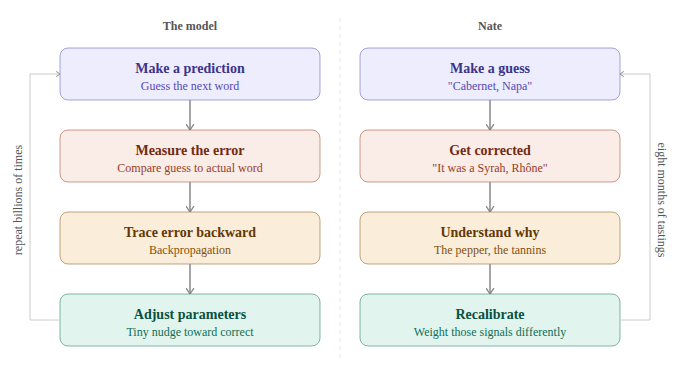
Then Nate recalibrated, probably not consciously and definitely not dramatically. He made a small, specific adjustment to the way he weighted those signals.
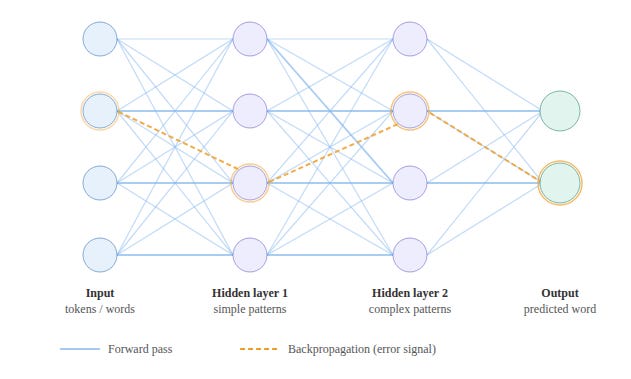
The model does the same thing. It reads a sentence, predicts the next word, and checks its guess against the actual word. Wrong? The system traces the error backward through its layers — that’s the “back” in backpropagation — and makes a tiny adjustment to the parameters responsible. Then it does it again. And again. Across billions of examples. The “wrongness” is the curriculum, it’s how the model learns.
The Architecture That Makes It Possible
A single correction doesn’t teach you anything lasting. What builds real understanding is structure, through layers of pattern recognition, each one building on the last.
Your brain isn’t one thing. It’s a hierarchy. Early visual processing happens in one region, object recognition in another, contextual meaning in yet another. You don’t consciously manage this. The layers just work, each one handing off increasingly refined information to the next.
A neural network is built on the same principle. It’s a stack of layers, each one a set of mathematical functions that take input, transform it, and pass it forward. The early layers learn simple patterns: this word tends to follow that word. The deeper layers learn something harder: this sentence implies a question is coming. This paragraph is an argument. This author is being sarcastic.
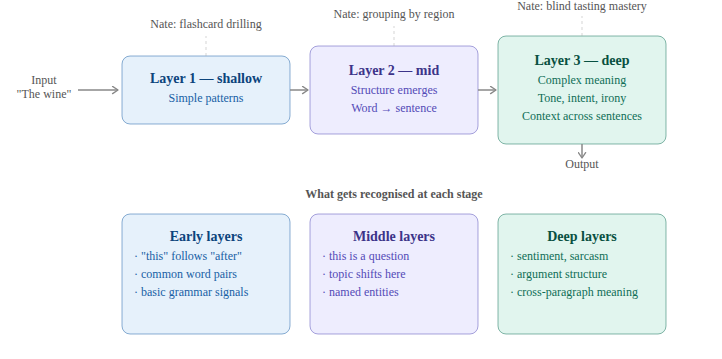
Nate’s early flashcard phase was the shallow layer work — basic pattern matching, raw association. His ability, a year later, to taste a wine and place it within a few years and two appellations? That’s deep layer processing. The surface signal (flavor, aroma, structure) is being mapped against a rich internal model built from thousands of previous encounters.
The model builds that same internal architecture — not from wine, but from language. Layer by layer, correction by correction, until the patterns run deep.
Where It Stops Feeling Familiar
Nate studied for eight months, worked through maybe a few thousand flashcards, and tasted hundreds wines. That’s an extraordinary amount of human effort, and it produced something genuinely remarkable: a trained expert.
A large language model trains on hundreds of billions of words. It processes more text in a single training run than a person could read in thousands of lifetimes. It makes and corrects predictions at a scale that has no human equivalent. The mechanism — make a guess, measure the error, adjust — is the same one your brain uses. The scale is where it stops feeling familiar and starts feeling like something else entirely.
OpenAI’s GPT-4 model is estimated to have somewhere in the range of a trillion parameters.1 Remember, parameters are the individual adjustable values that get tuned through training. The human brain has roughly 86 billion neurons, with trillions of synaptic connections between them. The comparison is imperfect, parameters and neurons aren’t the same thing, but the rough magnitude gives you a sense of what we’re dealing with.
This isn’t meant to make AI feel superhuman. It’s meant to make the difference in scale land emotionally. The mechanism is humble and familiar. The execution is something else entirely.
What the Model Actually Knows
After training, a well-tuned model has something that genuinely resembles knowledge. It has generated patterns so deeply encoded, they function like understanding. Ask it about the French Revolution and it doesn’t look anything up. It navigates a vast internal map built from millions of documents, cross-referenced and weighted through billions of corrections.
But here’s the thing Nate figured out (eventually) … knowing facts and reading a room are different skills.
He could identify a Côtes du Rhône blind. That was the exam. What came after — learning which bottle to recommend for a specific night out with a specific group of friends, when a friend needed a story behind the wine and when one was more concerned with price, when to educate and when to simply pour — that was something the flashcards couldn’t give him. That required a different kind of intelligence. Contextual. Relational. Aware of the whole situation, not just the glass in front of him.
That contextual awareness is the hardest problem in AI. It’s also exactly what Part 3 is about.
Because knowing a lot of things is one thing. Understanding what those things mean right now, in this conversation, for this person — that’s the problem the transformer architecture was built to solve.
Next Up in Part 3: How ChatGPT Actually Thinks — the attention mechanism, transformers, and the 2017 paper that changed everything.
1 OpenAI notably refrained from officially disclosing the exact number of parameters in GPT-4. However, the expert consensus (informed by widely cited industry leaks and reports) is that GPT-4 is a Mixture of Experts (MoE) model with approximately 1.76 trillion parameters. Read more here: https://the-decoder.com/gpt-4-has-a-trillion-parameters/