
The Captain & the Protocol of the Seas
How AI Agents and MCP Are Quietly Changing What AI Can Do

I was seventeen years old, on the San Francisco Bay with just a buddy of mine.
We were sailing a 29er, a high-performance racing skiff and the junior version of the 49er, which is an olympic class boat. The boat is powerful, fast, and can be a huge adrenaline rush when sailing in medium to windy conditions (watch the video below if you don’t believe me). But without wind, it’s an utterly helpless boat design with no way to propel forward.
We’d been out on the water for a few hours and were working our way back toward the harbor when the Bay went flat and quiet. If you’ve spent time on San Francisco Bay in the winter, you know this particular silence. The wind doesn’t just fade. It sort of just shuts off, especially late in the day like it was.
The problem was the current. The Bay’s tidal currents are strong and unforgiving, and that afternoon there was a strong ebb tide, which means the current was pushing the water towards the Golden Gate and out into the ocean. Without wind, we had no propulsion, and a 29er has no engine. We were drifting, slowly and steadily, in exactly the wrong direction. The sun was starting to set and my anxiety was starting to rise.
Eventually, a powerboat spotted us and came over. The captain tossed us a tow line. We made it back to the dock well after dark, shaken but fine. In the chaos of the moment, I didn’t think much about why that interaction worked so cleanly: two vessels that had never met, operating in entirely different ways, coordinating instantly in an emergency. The guys on the boat knew we needed help, pulled up alongside us, tossed us a tow line, and after securing the line to our mast we were underway almost immediately. It just worked.
I’ve been thinking about that afternoon a bit lately. Because it turns out it’s a pretty good way to conceptualize how AI agents and MCP work, two ideas that are quietly reshaping what AI can actually do.
From answering to acting
Most people’s experience with AI so far has been interacting with a chatbot like ChatGPT, Gemini, or Claude. You type something, the AI responds. You ask a question, it gives you an answer. Maybe you go back and forth a few times. It’s a conversation, useful and often impressive, but fundamentally reactive. The AI sits and waits. You prompt it. It replies.
That is changing. The shift happening right now in AI, one that most people outside the industry haven’t fully registered yet, is from “AI that responds” to “AI that acts.” The technical term for this is an AI agent.
An AI agent is given a goal, not just a prompt. And then it figures out how to pursue that goal across multiple steps, making decisions along the way, using tools, adjusting course as needed, without you having to hold its hand through every move. You don’t ask it questions. You give it something to handle, a task to manage and complete.
Think about what a skipper does on a sailboat. The skipper isn’t the one grinding the winches, adjusting the sails, or navigating the chart. The skipper holds the destination in mind, observes the conditions and obstacles like wind, current, and other boats, and is responsible for directing the whole operation. When things change, the skipper adapts. When something unexpected happens, the skipper makes a call. The goal stays constant, but the path to it shifts in real time.
That’s what an AI agent does. It’s not a faster search engine. It’s not a smarter autocomplete. It’s a system that can be handed a goal and pursue that goal autonomously, across many steps, in a way that a colleague might if you handed them a task and said, “handle this.”
But “handle this” is doing a lot of quiet work in that sentence. What does handling something actually look like on the inside? Let’s take a deeper look.
What’s actually happening behind the screen
Say you tell an AI agent: “Book me a trip to Chicago next Tuesday for the Henderson pitch. Keep it under $400, and don’t let it conflict with anything on my calendar or violate our travel policy.”
A less capable system might work through that request one step at a time: check the calendar, then search flights, then check policy, in sequence. But that’s not actually how a good skipper runs a crew, and it’s not how a good agent works either. A skipper doesn’t wait for one crew member to finish trimming the sail before telling another to check the chart. They call out several jobs at once, to several people, because the boat doesn’t have time for a queue.
A capable AI agent does the same thing. Rather than working through the Chicago trip as one long chain, it sends out several sub-agents at the same time: one to check your calendar for conflicts, one to search flights under $400, and one to pull the company’s travel policy for anything relevant to this trip. Three jobs, three sub-agents, all running in parallel, all reporting back to the main agent independently.
Here’s where it gets interesting. Say the calendar comes back clear. The flight search comes back with a $310 option that departs early Tuesday morning and returns that same night, a tight but doable turnaround for a single pitch meeting. The travel policy comes back with something neither of the other two sub-agents had any reason to know: the Henderson pitch is a two-day, in-person engagement, so the trip requires a hotel stay, and company policy requires the flight to arrive the evening before, not the morning of.
That single fact changes everything downstream. The cheapest flight no longer makes sense on its own terms, and now there’s a hotel to book that nobody had been asked to find. The orchestrating agent catches both: it goes back to the flight sub-agent with a new constraint (arrive the evening before instead), and it spins up a new sub-agent on the fly to find a hotel near the venue for that night. Neither the flight sub-agent nor the policy sub-agent was equipped to notice any of this. Recognizing the downstream consequences and generating a new task in response is the orchestrating agent’s job.
So the main agent reconciles the three original answers, catches the conflict, and works two threads in parallel: the flight sub-agent re-runs its search and comes back with a $375 option landing the evening before, while the new hotel sub-agent finds a room a few blocks from the pitch for $140. Both come back, both fit, and now everything reconciles. The agent either books the full trip, flight and hotel together, or returns to you with one clean recommendation.
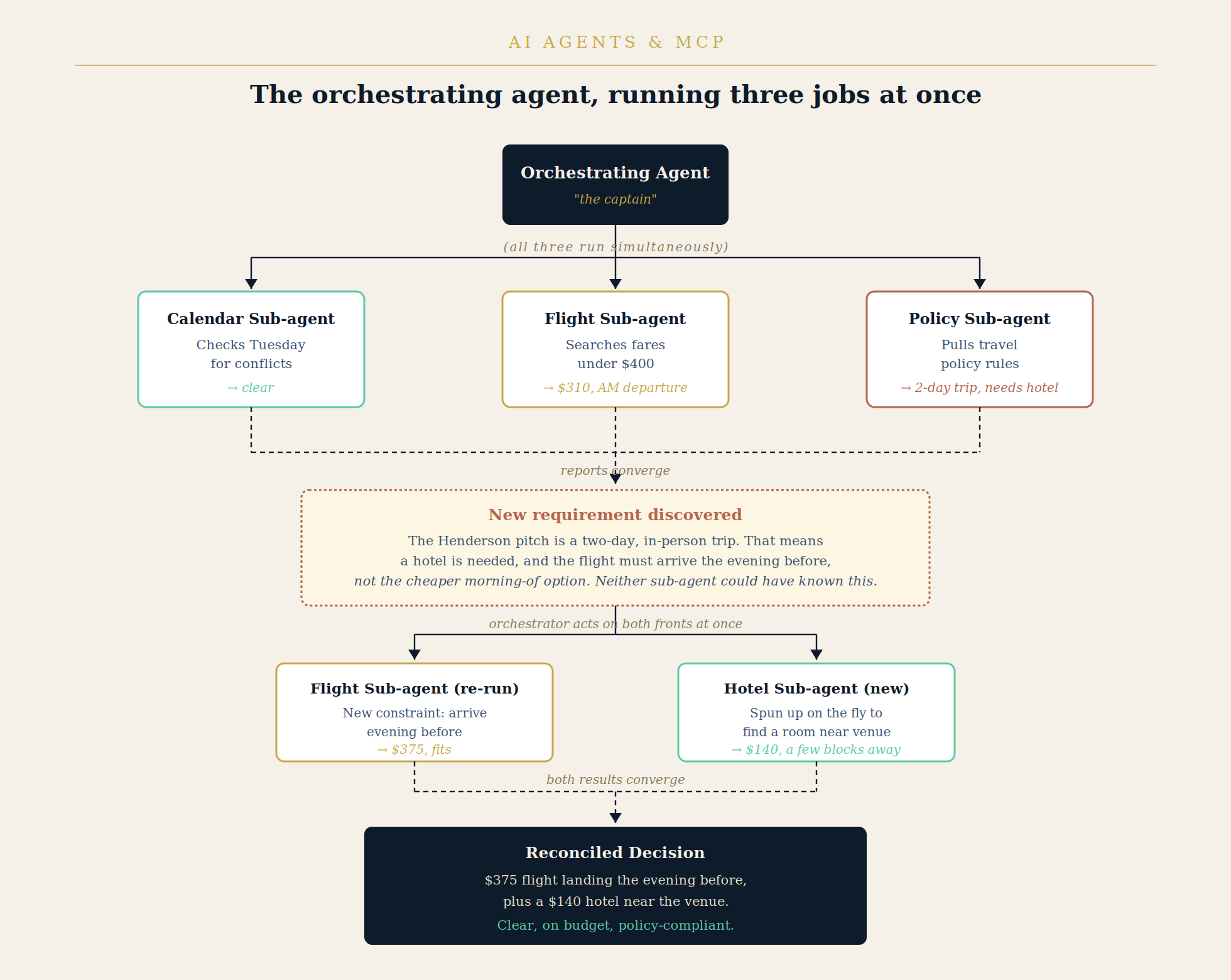
No single piece of that is impressive on its own. Checking a calendar is trivial. Searching flights is trivial. What’s new is that nothing required you to coordinate any of it, including the part where the first answer turned out to be wrong and needed a second pass. The agent held the goal, ran multiple things at once, caught a conflict between them, and looped back to fix it before bringing you a finished answer. That coordination, not any single step, is the actual capability.
The rules everyone agreed to follow
Here’s the thing about that time on the SF Bay when I almost got swept out to sea and was fortunate enough to have a powerboat come to my aid. The tow from the powerboat worked seamlessly, but not because the captain knew us, or because we had some special agreement in place, or because there was a dispatcher coordinating the whole thing. It worked because every vessel on the water, from a two-person racing skiff to a commercial tanker, is operating under the same set of rules. They’re called COLREGs (Collision Regulations) or known more formally as the Convention on the International Regulations for Preventing Collisions at Sea (and sometimes more informally called “the rules of the road”). Every country. Every boat. Same rulebook. When two vessels need to interact, they already share a common language for doing it. The protocol exists before the encounter does.
AI agents need the same thing. Go back to the Chicago trip. When the calendar sub-agent checked availability, it didn’t have some custom-built backdoor into your specific calendar app. When the flight sub-agent searched fares, it wasn’t specifically wired into that one airline’s booking system. Historically, that kind of access required custom engineering for every single pairing, this agent hand-built to understand that calendar app, that one hand-built to understand that one airline. Multiply that across every tool an agent might ever need to touch, and you can see the problem. It’s like requiring every boat captain to negotiate a personal agreement with every other vessel before entering the Bay.
Model Context Protocol, or MCP, is the COLREGs of AI. It’s an open standard, developed by Anthropic, that defines how AI agents communicate with external tools and data sources. Here’s roughly how it works, using the calendar check as the example:
The calendar app describes itself. Using MCP, it publishes what it can do, in this case “check availability for a given date,” in a standard format any MCP-compatible agent can read.
The agent makes a request. It asks for availability on a specific date, in the standard structure MCP defines, rather than some proprietary format only that one calendar app understands.
The tool returns a structured answer. Not a paragraph of text the agent has to interpret, but a clean, predictable response, busy or free and when, that the agent can immediately act on.
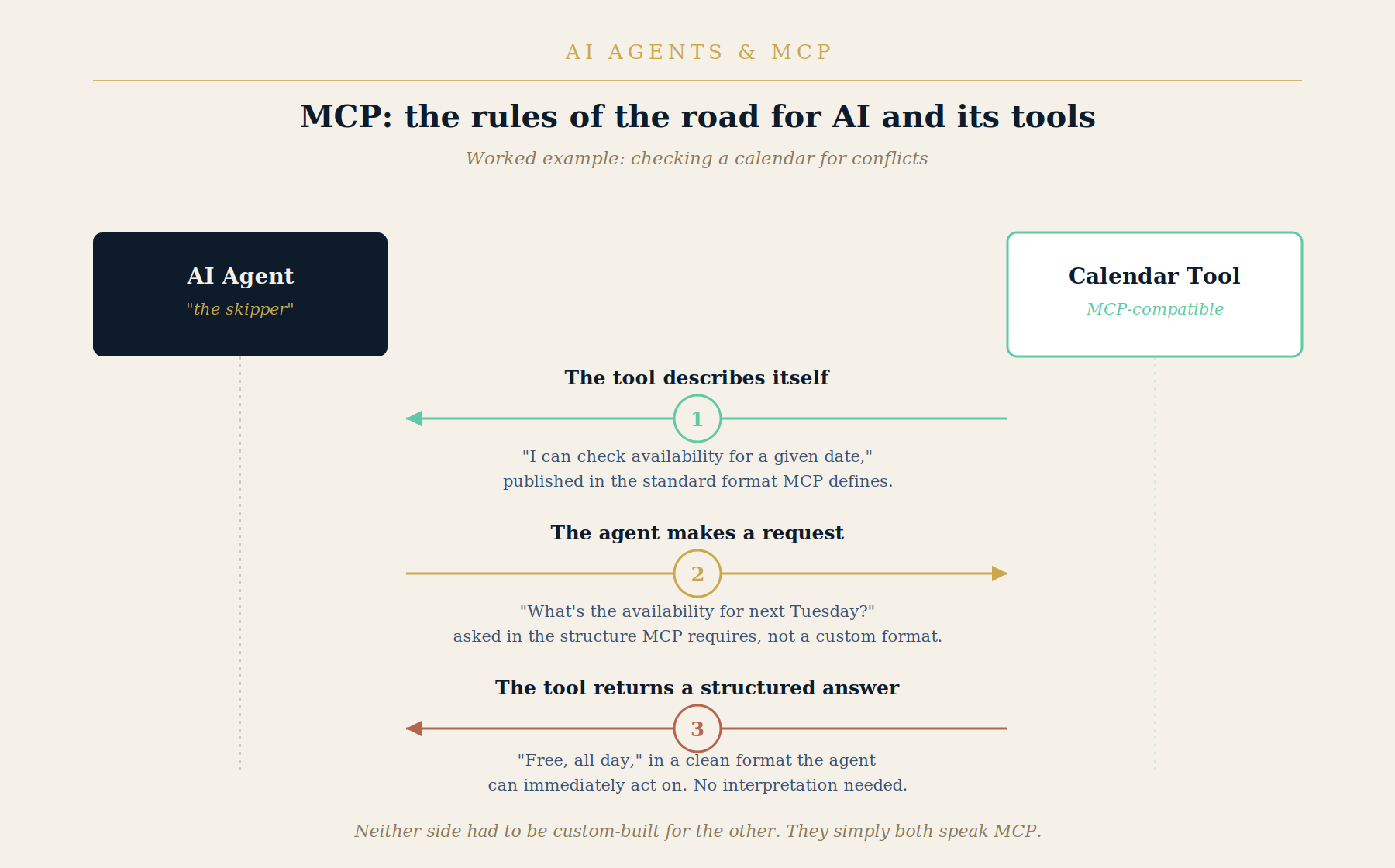
That’s the whole trick. The calendar app never had to know anything about this particular agent. The agent never had to be custom-built for this particular calendar app. They simply both speak MCP, the same way every boat operator on the Bay speaks COLREGs. Any MCP-compatible tool, whether it’s a calendar, a flight search, a travel policy document, or an expense system, can plug into any MCP-compatible agent. No custom integration required. The protocol exists before the encounter does.
The skipper and the “rules of the road” aren’t the same thing, but neither works without the other. A brilliant captain with no shared framework for navigating around other vessels is a hazard. A universal protocol with no capable actor to use it is just paperwork. Together, they’re what make the waterways functional. Without them, it would be utter chaos.
Why this matters now
We are early in the age of AI agents. Most of what exists today is still closer to the “ask a question, get an answer” model, which is genuinely useful, but a fraction of what’s coming. The next wave isn’t a smarter chatbot. It’s AI that handles things, quietly running multiple sub-agents in parallel and reconciling their results in the background while you focus on the parts of your work that actually need you.
For anyone leading a team, running a business, or navigating a career in a world increasingly shaped by AI, this distinction is worth holding onto. The question is no longer just “what can AI tell me?” It’s “what can AI do?” Increasingly, those are very different questions with very different answers.
That afternoon on the Bay, the wind died and we lost control of the situation. What saved us wasn’t skill or preparation (although that was important as well). It was the existence of a shared standard that made coordination between two strangers possible the moment they needed it. We didn’t have to explain what we needed. The protocol already knew.
The boats are smarter now. And the rules of the road are being written.